

By Oz Unpacked · Updated
A skills assessment checks whether your qualifications and skills meet the standard for a nominated occupation in Australia. It is carried out by the relevant assessing authority, which looks at the evidence required for that occupation and assessment pathway. Depending on the pathway, this can include your study, employment history and practical skills.
For many skilled visas, the result is one of the documents you need before you can move ahead. Understanding it early helps you choose the right occupation, collect useful evidence and avoid paying for an assessment that does not suit your plans.
Why is a skills assessment needed?
People arrive with qualifications and work experience from different education systems and workplaces. An assessment gives the migration process an occupation-specific benchmark to work with: does the evidence meet the Australian standard required for the nominated occupation?
The assessing authority decides the assessment outcome. Home Affairs uses that outcome alongside the other requirements for the visa. A positive result supports the skills part of your application; you will still need to meet the visa's requirements for matters such as English, age, nomination or sponsorship where they apply, health and character.
The criteria are worth reading before you request documents: they set out which qualifications are relevant, what your employment records need to show and any further assessment stages.
Where does it fit in the migration process?
For the points-tested subclass 189, 190 and 491 pathways, plan to obtain your skills assessment before submitting your Expression of Interest (EOI). SkillSelect asks for details including the assessing authority, assessment date and reference number.
From there, keep an eye on the result's validity while you wait. The standard visa guidance requires a suitable assessment at invitation, generally obtained within the previous three years or within the shorter validity period stated by the authority. There is a published policy for certain assessments obtained during the invitation period, discussed in the FAQs below; completing the assessment before your EOI remains the sensible way to prepare.
The timing changes with the visa and stream:
| Pathway or stage | What to prepare |
|---|---|
| 189, 190 and 491 points-tested pathways | Obtain the relevant assessment before submitting your EOI. Check that it meets the visa's validity requirements when you are invited. |
| State or territory nomination | Check the state's evidence requirements and deadlines as well as the visa rules. An assessment may be part of the documents you need for nomination. |
| 186 Direct Entry | Most applicants need a positive skills assessment before lodging the visa application. Exemptions apply. Other 186 streams have different assessment requirements. |
| 482 Skills in Demand | Check whether a mandatory assessment applies to your circumstances and whether an exemption is available. Where it is mandatory, it must have been undertaken or commenced within the three years before the visa application, and the application needs the assessment reference. Home Affairs encourages completing it first. |
For employer-sponsored visas, the stream and your circumstances determine the assessment requirement. For the 482 visa, Home Affairs can also request an assessment where one was not mandatory at application.
If you are considering a points-tested route, our guides to the subclass 189 visa, subclass 190 visa and subclass 491 visa explain the wider process around the assessment.
How do you find the right assessing authority?
Start with the occupation that best matches the work you actually do. Look beyond the title on your business card: duties, responsibility level and the relevance of your qualifications can all matter to the assessment.
You can use our Australian occupation directory to search an occupation name or ANZSCO code, then open the relevant profile. If the search shows several similar occupations, compare the descriptions before choosing one.
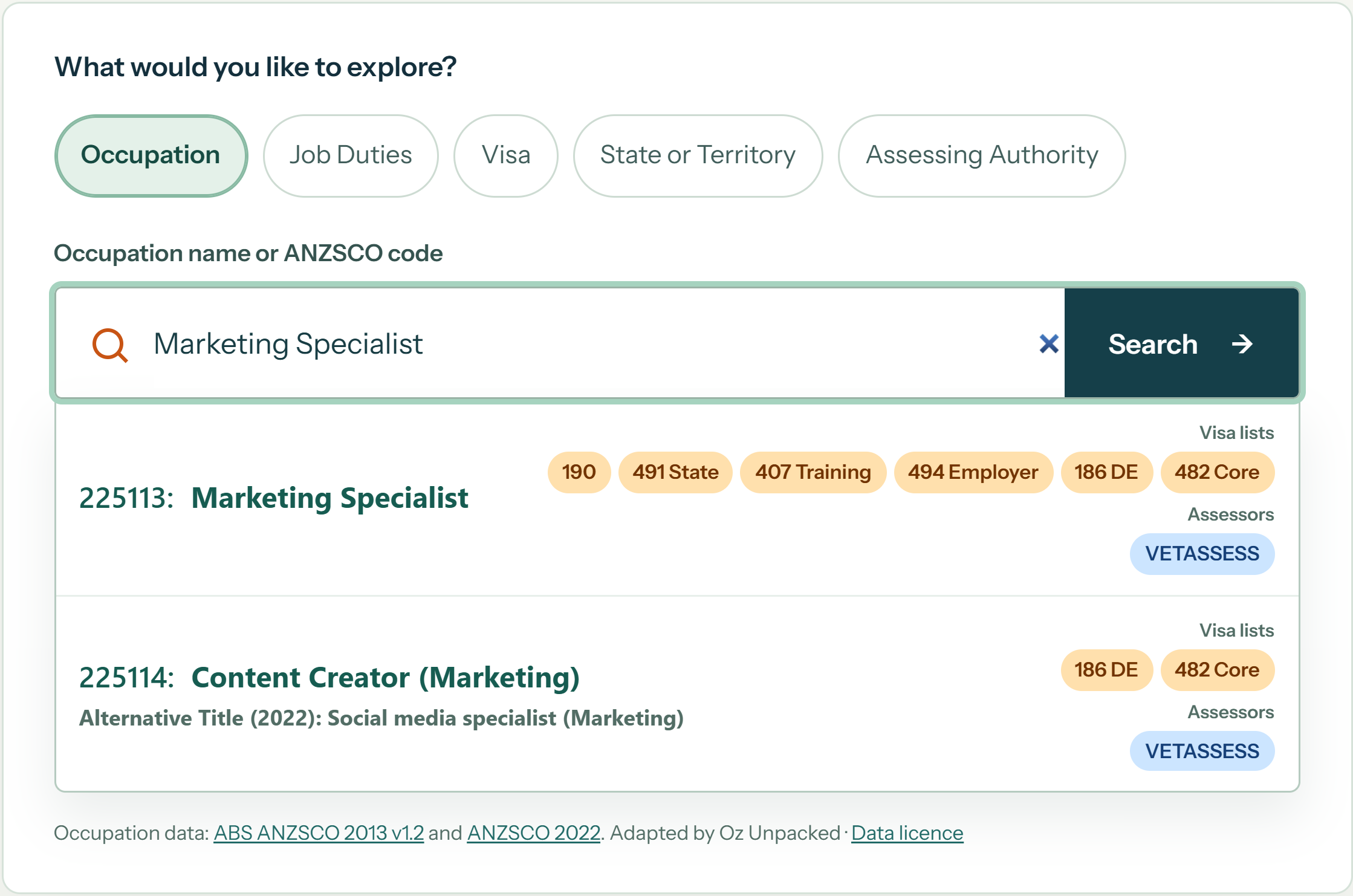
Once you have found a likely match, confirm that the occupation is eligible for the visa you are considering, then check its designated assessing authority and assessment pathway. An organisation may offer several assessment services, so choose the one intended for your occupation, background and visa purpose.
Use the profile to reach the actual criteria
The Assessment tab in our Marketing Specialist occupation profile shows VETASSESS and links to its occupation criteria.
For this occupation, VETASSESS assesses both qualifications and employment under its Group B pathways. The amount and type of employment evidence depend on the pathway, including how closely the qualification relates to the occupation. Your employment evidence therefore matters alongside your qualification.
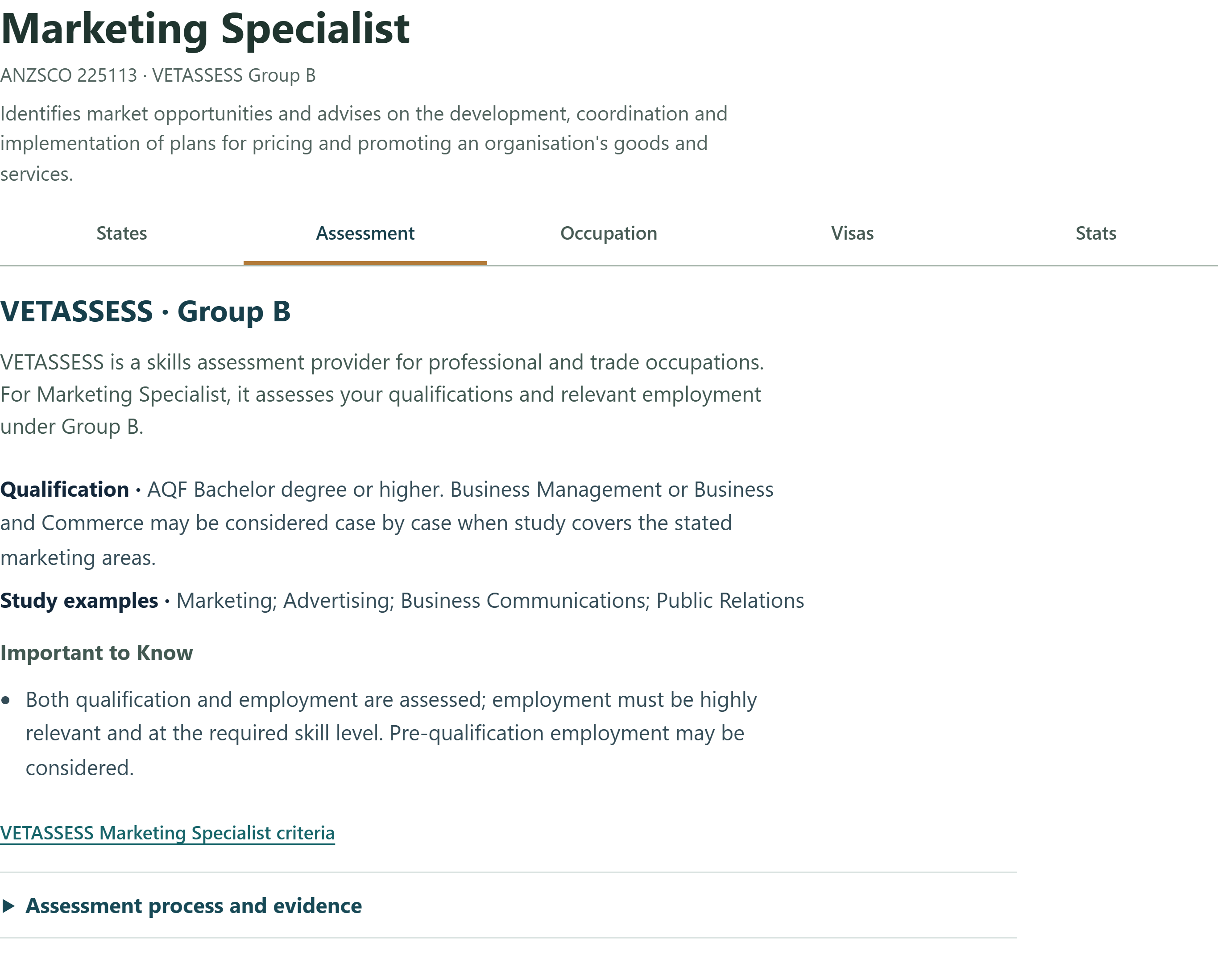
Use the authority's current instructions to prepare your application. If the profile lists more than one assessor or pathway, confirm which one covers your occupation and intended visa before choosing a service.
What does the authority actually check?
The evidence depends on your occupation and assessment program. Some assessments are mainly document-based; others include a technical interview, practical assessment or another competency stage.
The checklist may ask for:
- Identity records: documents establishing who you are and explaining any name differences across your records.
- Qualifications: award certificates, transcripts and, where requested, details of the subjects you studied.
- Employment evidence: references describing your duties, dates, hours and level of responsibility, supported by the payment or other records the authority requires.
- Pathway-specific evidence: this might include registration, English results, a competency submission or a technical assessment, depending on the program.
Read the document instructions before asking an employer for a reference. A short letter confirming your job title may leave out the duties or working hours the authority needs. It is easier to request the right information at the outset than to return to a former employer several times.
Follow the authority's rules for translations, certification and acceptable evidence. If a record is missing, look for its published alternatives or ask the authority how to proceed. Describe the duties you actually performed and support them with the records the authority asks for.
How do you apply for a skills assessment?
Once the occupation and assessment pathway are clear, the process usually follows this sequence:
- Read the eligibility criteria and document checklist. Confirm that you are applying for the service intended for your occupation, background and visa purpose.
- Prepare the evidence. Gather the qualification and employment records required by that pathway, including any translations or supporting documents.
- Submit the application and pay the relevant fee. Use the authority's application process and keep a copy of what you submit.
- Complete any further requests or assessment stages. Respond to document queries and attend interviews or practical assessments where required.
- Read the outcome carefully. Check the occupation, outcome, dates and any comments about your qualifications or employment. Keep the result and reference details for the next stage of your migration process.
Before paying, make sure the assessment is suitable for the visa purpose you have in mind. An authority can offer different programs, and a result intended for one purpose may not meet the requirements of another.
What does a positive outcome let you do?
A suitable positive outcome gives you the occupational assessment evidence required for the relevant visa pathway. For a points-tested route, you can use its details in your EOI and provide the result with your visa application when invited.
Take time to read any employment findings. The years you have worked and the years you can claim for skilled employment points may differ. For example, VETASSESS identifies a Date Deemed Skilled: the date you met its qualification and employment criteria for the occupation. Employment used to meet those criteria may be excluded from its points test advice. Home Affairs determines the visa points you can claim under its rules.
What about professional registration or a licence?
If you work in a regulated occupation, check the requirements for practising in Australia as well. A migration assessment generally does not give you permission to practise a profession or perform licensed work. Registration or licensing may require its own application and evidence.
There are occupation-specific arrangements: Home Affairs accepts certain Australian medical registration or legal admission evidence for the skills requirement on relevant skilled pathways. That is why it helps to follow the rules for your occupation rather than assume that registration and assessment always work the same way.
How much does it cost, and how long will it take?
There is no single skills assessment fee or processing time. The authority, assessment program, documents and any further assessment stages affect both.
Look up the current fee for the exact service you need. Check whether additional charges could apply for a technical assessment, an employment assessment, priority service or a later review. You may also need to budget for translations or obtaining documents.
For timing, distinguish the authority's processing estimate from the time it will take you to prepare a complete application. Obtaining older transcripts or detailed employment references can take time before the assessment has even started. Read how the authority defines its processing period and what happens if it asks for more information.
Frequently asked questions
Can I submit an EOI before my skills assessment is ready?
For the points-tested skilled pathways, Home Affairs directs you to obtain the relevant assessment before submitting your EOI. You need its details to complete the skills assessment information. Use the preparation stage to choose your occupation, gather the required evidence and obtain the result, then enter accurate information in your EOI.
What if I have already been invited and my assessment is pending or expired?
Act promptly. Home Affairs publishes a policy accepting a suitable assessment for the applicant's nominated skilled occupation obtained within the 60-day invitation period, following the Thapa decision. Its pages also retain standard wording about holding a valid assessment at invitation.
Get advice from a registered migration agent or Australian legal practitioner about how the current policy applies to your invitation and result. It does not extend the invitation deadline or establish that other invitation-time requirements can be met later. Do not assume the same treatment applies to a partner's assessment.
Does an Australian qualification mean I can skip the assessment?
An Australian qualification may give you access to a particular assessment pathway. You still need to meet the assessment requirement for your visa and stream, including any employment evidence that pathway requires. Read the authority's instructions for graduates of your course alongside the current visa requirements.
Do I need IELTS or another English test for a skills assessment?
English evidence depends on the authority and assessment pathway. Some require test results; others have different arrangements. For example, ANMAC currently says applicants for its modified skills assessment do not need to provide English test results for that assessment.
Check the assessment instructions alongside the English requirements for your visa and, where relevant, professional registration. An assessment pathway that does not ask for a test does not settle those other requirements.
Can my partner's skills assessment help our points score?
A partner's suitable skills assessment can contribute to the 10-point skilled partner category if all its conditions are met at invitation. Your partner must:
- be under 45 and have competent English;
- be applying for the same visa subclass as you and be neither an Australian citizen nor a permanent resident; and
- nominate an occupation on the same skilled occupation list as yours, with a suitable assessment for that occupation obtained for a purpose other than a subclass 485 visa.
The 5-point category for a partner with competent English does not itself require a skills assessment; your partner must also be applying for the same visa subclass and must not be an Australian citizen or permanent resident. Check the points table for the category you intend to claim before arranging an assessment solely for partner points.
How long does a skills assessment remain valid?
Check both the result letter and the visa rules. For the points-tested 189, 190 and 491 pathways, the standard guidance uses a three-year limit before invitation, or the shorter validity period stated by the assessing authority.
An authority's own treatment of its letter may differ from the period Home Affairs accepts for migration. Engineers Australia, for example, says its assessment outcome is valid indefinitely for its own purposes, while Home Affairs applies migration validity requirements. Check the dates again if you have been waiting for an invitation or are reusing an earlier result.
What can I do if the assessment is unsuccessful?
Read the outcome and reasons before deciding what to do next. Depending on the authority and the issue, there may be a review, appeal or new application process. Check the available options, evidence rules, fees and deadlines with that authority.
For example, a missing document calls for a different response from a finding that your qualification or employment does not meet the chosen pathway. Establish what needs to change before paying for another application.
Your next step
Find the occupation that best fits your work, then read the relevant authority's assessment criteria. Our occupation directory can help you make that connection. Once you know which pathway to investigate, you can start collecting the evidence it actually asks for.
Official resources
- Home Affairs: skills assessments and the published invitation-period policy
- Home Affairs: submitting an Expression of Interest
- Home Affairs: subclass 189 points-tested requirements
- Home Affairs: subclass 190 requirements
- Home Affairs: subclass 491 main applicant requirements
- Home Affairs: subclass 186 Direct Entry
- Home Affairs: subclass 482 Core Skills stream
- Home Affairs: skilled visa points table, including partner points
- VETASSESS: choosing an occupation and understanding assessment findings
- VETASSESS: Marketing Specialist assessment criteria
- VETASSESS: professional occupation assessment fees
- Engineers Australia: migration skills assessment and outcome information
- ANMAC: modified skills assessment requirements
- ANMAC: full assessment and English evidence questions
- ACS: employment evidence for skills assessment
- Trades Recognition Australia: Migration Skills Assessment program
- VETASSESS: trade assessment stages
- NSW: supporting information and validity when applying for nomination
Official guidance checked 21 November 2026. Directory images show the interface captured on that date; occupation and assessment requirements can change. Use the current authority and visa instructions when preparing an application.


