Hobart City
A central base if work, school or regular errands are on the Hobart side of the Derwent.
Everyday Life: Older streets and central convenience vary block by block; parking and the journey from a particular home can make the difference.


Your Relocation Guide
Compare Hobart, Launceston and the north-west coast, with practical advice on housing, work and getting settled.
Read The Guide →Cradle Mountain-inspired alpine landscape
Where you live in Tasmania shapes your journeys to work, school and healthcare. Compare homes around Hobart and the Eastern Shore with options in Launceston and on the north-west coast, then try the trips you would make each week.
The 2021 Census counted 557,571 Tasmania residents, with a median age of 42.
Check your visa and work conditions, Medicare or other cover, school requirements and overseas-licence rules. Budget for temporary accommodation and the first rent payment.
Try the work and school journeys from possible homes. Check school intake, removals, vehicle requirements and licence steps.
These five areas cover Hobart, the Eastern Shore, Launceston and the north-west coast. Compare the homes you find with the places your household will visit most often.

| Place | When It May Suit | Everyday Life |
|---|---|---|
| Hobart City | A central base if work, school or regular errands are on the Hobart side of the Derwent. | Older streets and central convenience vary block by block; parking and the journey from a particular home can make the difference. |
| Glenorchy City | A northern Derwent option with regular trips toward Hobart. | Bus routes and heating vary by property; a lower rent can still mean a longer daily journey. |
| Eastern Shore (Clarence) | An eastern-shore base for households with cross-river trips. | Bridge traffic and bus connections can shape the commute to Hobart; Clarence covers a wide range of neighbourhoods. |
| Inner Launceston | A northern-city option when work and everyday activities centre on Launceston. | A central address may shorten regular trips, while housing and street character change across inner suburbs. |
| Greater Devonport | A north-west coast base with a different regional routine from Hobart or Launceston. | Local services may be close, but regional journeys and work hours matter if you rely on a car. |
A central base if work, school or regular errands are on the Hobart side of the Derwent.
Everyday Life: Older streets and central convenience vary block by block; parking and the journey from a particular home can make the difference.
A northern Derwent option with regular trips toward Hobart.
Everyday Life: Bus routes and heating vary by property; a lower rent can still mean a longer daily journey.
An eastern-shore base for households with cross-river trips.
Everyday Life: Bridge traffic and bus connections can shape the commute to Hobart; Clarence covers a wide range of neighbourhoods.
A northern-city option when work and everyday activities centre on Launceston.
Everyday Life: A central address may shorten regular trips, while housing and street character change across inner suburbs.
A north-west coast base with a different regional routine from Hobart or Launceston.
Everyday Life: Local services may be close, but regional journeys and work hours matter if you rely on a car.
Use the maps to see where these areas sit, then explore streets and travel from the properties on your shortlist.
These maps show broad locations, not individual homes or journey times.
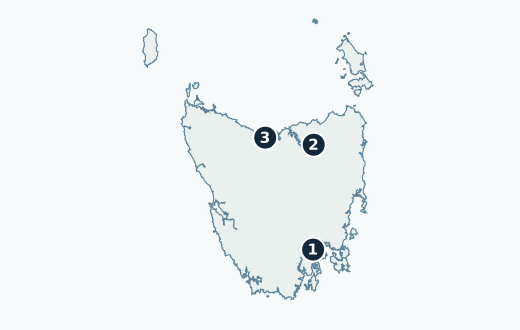
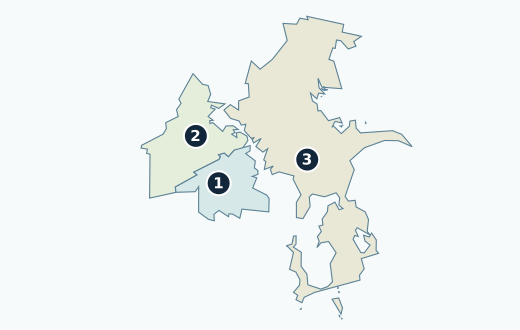
The June-quarter 2026 rent figures give a starting point for comparing two- and three-bedroom homes. Check current listings for the type of dwelling you want.
Median weekly rent on new residential bonds · A$ · June quarter 2026 · all dwelling types
| Bond-report area | Dwelling measure | Median weekly rent | Row count | Approx. calendar month |
|---|---|---|---|---|
| Hobart City | 2 bedrooms · all dwelling types | A$550 | Not published | A$2,383 |
| Glenorchy City | 2 bedrooms · all dwelling types | A$500 | Not published | A$2,167 |
| Eastern Shore | 2 bedrooms · all dwelling types | A$520 | Not published | A$2,253 |
| Inner Launceston | 2 bedrooms · all dwelling types | A$483 | Not published | A$2,093 |
| Greater Devonport | 2 bedrooms · all dwelling types | A$450 | Not published | A$1,950 |
| Hobart City | 3 bedrooms · all dwelling types | A$680 | Not published | A$2,947 |
| Glenorchy City | 3 bedrooms · all dwelling types | A$600 | Not published | A$2,600 |
| Eastern Shore | 3 bedrooms · all dwelling types | A$600 | Not published | A$2,600 |
| Inner Launceston | 3 bedrooms · all dwelling types | A$560 | Not published | A$2,427 |
| Greater Devonport | 3 bedrooms · all dwelling types | A$530 | Not published | A$2,297 |
2 bedrooms · all dwelling types
2 bedrooms · all dwelling types
2 bedrooms · all dwelling types
2 bedrooms · all dwelling types
2 bedrooms · all dwelling types
3 bedrooms · all dwelling types
3 bedrooms · all dwelling types
3 bedrooms · all dwelling types
3 bedrooms · all dwelling types
3 bedrooms · all dwelling types
Hobart City’s two-bedroom benchmark is A$550 a week, or about A$2,383 per calendar month. Compare that figure with current listings, then add food, heating, transport, insurance and childcare to your own budget.
Tasmania’s Residential Tenancy Act caps an ordinary residential security deposit at four weeks of rent. Rent in advance depends on the agreed payment period; these examples assume an initial two-week payment. Confirm the terms in the lease.

Each example uses a June-quarter 2026 bedroom median across all dwelling types. A particular house or apartment may cost more or less. The examples show four weeks of bond and an assumed two weeks of initial rent.
2-bedroom all-dwelling example · Hobart City
Illustrative move-in housing cash: A$3,300
2-bedroom all-dwelling example · Glenorchy City
Illustrative move-in housing cash: A$3,000
3-bedroom all-dwelling example · Eastern Shore
Illustrative move-in housing cash: A$3,600
3-bedroom all-dwelling example · Greater Devonport
Illustrative move-in housing cash: A$3,180
Calendar-month estimates equal weekly rent × 52 ÷ 12, rounded to whole dollars.
For the Hobart example, six weeks of rent totals A$3,300. Add an illustrative four-week bond of A$2,200, and housing over that period would need A$5,500. The first two weeks of rent are already in the six-week total. Add moving, bills and daily costs to your reserve.
Inspect a rental and record its condition before moving in. Read the bond and rent terms and use the Tenants’ Union starting-tenancy guide. If buying, compare current properties and finance costs, check transfer duty and use PlanBuild for planning information at the address.
Look for roles in the town where you hope to live, then check the work address and hours against your housing options.
The 2021 Census recorded median weekly personal income of A$701 in Tasmania and A$805 nationally. Median weekly household income was A$1,358 and A$1,746 respectively. Compare a current job offer with your own housing and living costs.
In 2021, 11,541 Tasmanian residents worked in hospitals (except psychiatric hospitals), and 8,508 worked in other social assistance services. Check current vacancies, registration requirements, work rights and a possible partner’s options.
Household medians provide context, not a current salary guide.
Search for schools alongside a home. Tasmania’s intake-area finder shows primary and secondary areas and flags schools at capacity; ask the school about your child’s place.

Use the school intake-area finder for the address you are considering. Temporary-resident pupils need a TGEI Authority to Enrol letter. Tuition fees depend on visa subclass and circumstances; check the Temporary Resident Program.
Ask local childcare providers about places, hours and fees before fixing a work-start date. Check the school intake area again for the home you choose.
Check both your health cover and the care available near a possible home.
Medicare depends on residency or visa status, and some visitors may have reciprocal cover. Read healthdirect’s Medicare guide, then check eligibility with Services Australia and arrange suitable cover.
Use the Tasmanian Department of Health service finder for nearby care. Contact GPs, pharmacies and other providers about appointments and fees.
Look at travel at the times you would leave and return, especially for work, school and care trips.

Use the Tasmania bus timetable finder and official fares for the services you need. Compare first and last buses, connections, car travel and parking from each home.
Interstate, New Zealand and overseas licences follow different processes. Ask Service Tasmania which deadline, documents or tests apply to you, and check vehicle steps at the same time: interstate or New Zealand and overseas licence guidance.
Tasmania’s seasons will feel different in different homes and regions. Inspect the property for comfort and access throughout the year.
The Bureau of Meteorology’s Hobart Airport West station table gives historical weather context for one location. Check the forecast and local conditions for your address and travel dates.
Ask about heating costs and check insulation, ventilation, moisture and weatherproofing. Look up local road, park and property information for seasonal conditions and hazards.
Getting to know a place often starts with local routines as much as population figures.
At the 2021 Census, 30,186 Tasmanians identified as Aboriginal and/or Torres Strait Islander, or 5.4% of the state’s population.
These are separate measures of the state’s population.
Look for libraries, sport, council activities and language groups near your proposed home. Ask when they meet and how you would get there.
Tasmania’s short walks offer a way to explore each region from a possible home base. Check access and travel time before setting out.
Browse the Tasmania Parks & Wildlife Service short-walk collection and current notices.
The Coal Mines Historic Site on the Tasman Peninsula is one southern-region outing from a Hobart-area base.
Duck Reach follows the South Esk River from Cataract Gorge. Check conditions and access before a visit.

Fern Glade follows the Emu River and offers an outing from the north-west coast. Check current access before visiting.
Plan the first weeks around housing, regular journeys and enough cash until income begins.
Complete the licence and vehicle steps that apply to you, then update your budget from the bills you receive.
Hobart, the Eastern Shore, Launceston and the north-west offer different daily routines. Choose a base that works for your work, school, care and home. Read the related section.
It is the June-quarter 2026 three-bedroom, all-dwelling-types new-bond median for the report’s Clarence-excluding-Richmond area; it is not an asking rent for a particular house. Read the related section.
The examples allow for a bond of four weeks’ rent and a first payment of two weeks’ rent. Your lease may differ. The six-week rent reserve already includes that first fortnight. Read the related section.
Check the exact address and capacity with the school. Temporary-resident enrolment requires TGEI Authority to Enrol, while tuition status depends on visa subclass and circumstances. Read the related section.
The process differs for overseas, interstate and New Zealand licences. Ask Service Tasmania what applies to yours. Read the related section.
Eligibility depends on individual circumstances. Check Services Australia’s enrolment guidance for your visa or reciprocal position and arrange appropriate cover. Read the related section.
The rent figures show past agreements, while the best fit depends on available homes, total costs and your needs. Check current listings and property information. Read the related section.
Oz Unpacked Migration Guides
If Tasmania feels like a good fit, explore a self-guided migration resource for your occupation.
Find the guide that fits your work and use it to prepare your next steps in your own time.
Find Your Migration Guide →Educational resources for self-guided preparation. Check current official requirements for your circumstances.
Reviewed 18 October 2026. Rent figures are June-quarter 2026 new-bond medians by bedroom count across all dwelling types. They describe past agreements, not current asking rents. The report does not publish selected row counts or a house/unit split. Monthly estimates equal weekly rent × 52 ÷ 12, rounded. Population, income and community figures use the 2021 Census.
For housing and work: Tenants’ Union TasRents June 2026, Table 1 and area definitions, Residential Tenancy Act 1997, ABS Tasmania 2021 Census and ABS Australia 2021 Census. Glenorchy includes Granton; Eastern Shore excludes Richmond; Inner Launceston groups inner suburbs; Greater Devonport uses part A of a statistical area. The source excluded its one-bedroom Devonport value because of an error.
For schools, care and travel: school intake areas, temporary-resident enrolment, healthdirect Medicare guide, Tasmanian health-service finder, bus timetables, bus fares and overseas licence guidance.
For weather, walks and maps: Bureau of Meteorology Hobart Airport West data, Tasmania Parks & Wildlife Service walks, ABS ASGS 2021 state data and LGA data (CC BY 4.0 unless noted). Maps show broad localities, not properties. Watercolour scenes illustrate Tasmanian settings.
This guide does not include comparable sale prices, current vacancy figures or a complete moving-cost estimate. Check current school, transport, health and tenancy details with the linked authorities for your circumstances.


