Central Melbourne / CBD–St Kilda Rd
Central apartments can put work, shops and services close by.
Everyday Life: A short trip to central work may come with apartment living, traffic and street noise.


Your Relocation Guide
From Melbourne to Geelong, Ballarat and Bendigo, find a place that works for your budget and everyday life.
Read The Guide →Flinders Street Station, Melbourne
A home in central Melbourne will give you a different daily life from one in an outer suburb or regional city. Think about where you will work, how you will get around, and which schools or services your family needs. Victoria had 6,503,491 people at the 2021 Census (ABS).
Before choosing a home, check your visa and work conditions, healthcare cover, school enrolment and any fees for your children. If you drive, find out when you will need a Victorian licence. Allow for temporary accommodation and living costs until your income starts.
Get familiar with Victorian rental rules and the steps for transferring your licence and car registration. Try the work or school trip at the times you would actually travel, including the journey home.
There is more to the choice than Melbourne or regional Victoria. These places offer different kinds of homes and daily travel. Use them to start a shortlist, then compare homes you can actually rent with your work, school and care needs.

| Place | When It May Suit | Everyday Life |
|---|---|---|
| Central Melbourne / CBD–St Kilda Rd | Central apartments can put work, shops and services close by. | A short trip to central work may come with apartment living, traffic and street noise. |
| Footscray | An inner-west option with apartments and access to central Melbourne. | Central access is a draw; the walk to transport and the school zone will depend on the street. |
| Werribee–Hoppers Crossing | An outer-west option if you want to compare larger homes with the extra travel they may involve. | More space may mean more time on the road or train, especially if work is across Melbourne. |
| Dandenong | A south-eastern Melbourne option with both flats and houses in the rental figures. | Homes and transport vary by street; test the trip to work and nearby services. |
| Geelong–Newcombe | A bay-region option with local jobs and services, plus a V/Line connection to Melbourne. | Local work can make the day simpler; a Melbourne commute depends on train times and where the job is. |
| Ballarat | An inland regional city with its own housing market and train timetable. | An inland winter makes home heating worth checking, along with local travel. |
| Bendigo | Another inland city to consider if the local work and services suit your household. | A home near your usual destinations may matter more than a fast train to Melbourne. |
Central apartments can put work, shops and services close by.
Everyday Life: A short trip to central work may come with apartment living, traffic and street noise.
An inner-west option with apartments and access to central Melbourne.
Everyday Life: Central access is a draw; the walk to transport and the school zone will depend on the street.
An outer-west option if you want to compare larger homes with the extra travel they may involve.
Everyday Life: More space may mean more time on the road or train, especially if work is across Melbourne.
A south-eastern Melbourne option with both flats and houses in the rental figures.
Everyday Life: Homes and transport vary by street; test the trip to work and nearby services.
A bay-region option with local jobs and services, plus a V/Line connection to Melbourne.
Everyday Life: Local work can make the day simpler; a Melbourne commute depends on train times and where the job is.
An inland regional city with its own housing market and train timetable.
Everyday Life: An inland winter makes home heating worth checking, along with local travel.
Another inland city to consider if the local work and services suit your household.
Everyday Life: A home near your usual destinations may matter more than a fast train to Melbourne.
A cheaper home may still cost more to live in if it adds a long trip or another car. Compare current listings and the journeys you would make each week.
Use these maps to see where the places sit across Victoria and Melbourne. The numbered points show general locations; they do not mark individual homes or travel routes.
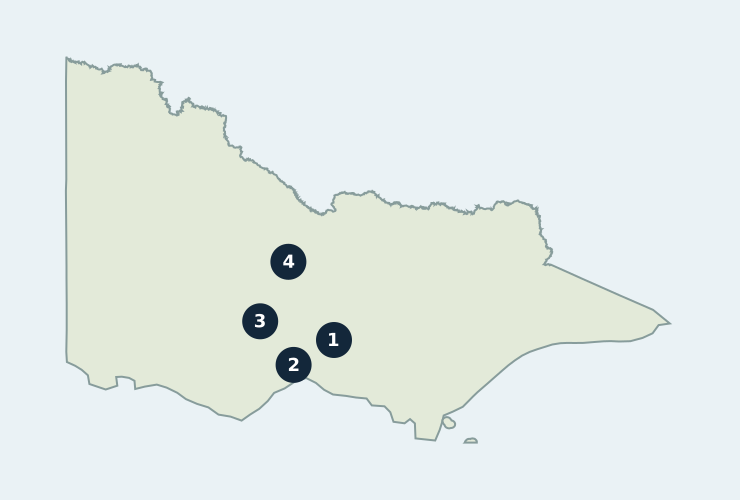

Map data: © OpenStreetMap contributors, ODbL. Points are approximate.
Rent will probably be one of your biggest decisions. The figures below show median weekly rent for new leases in the year to September 2025. They can help you compare areas, but check current listings for the homes available now.
Median weekly rent for new leases · year to September 2025
| Rental-report area | Dwelling | Median weekly rent | New lettings |
|---|---|---|---|
| CBD–St Kilda Rd | Two-bedroom flat | A$735 | 6,605 |
| Footscray | Two-bedroom flat | A$560 | 763 |
| Footscray | Three-bedroom house | A$640 | 141 |
| Werribee–Hoppers Crossing | Two-bedroom flat | A$405 | 485 |
| Werribee–Hoppers Crossing | Three-bedroom house | A$460 | 3,643 |
| Dandenong | Two-bedroom flat | A$450 | 598 |
| Dandenong | Three-bedroom house | A$560 | 321 |
| Geelong–Newcombe | Two-bedroom flat | A$460 | 315 |
| Geelong–Newcombe | Three-bedroom house | A$480 | 413 |
| Ballarat | Two-bedroom flat | A$360 | 174 |
| Ballarat | Three-bedroom house | A$410 | 583 |
| Bendigo | Two-bedroom flat | A$400 | 57 |
| Bendigo | Three-bedroom house | A$480 | 135 |
Two-bedroom flat
Two-bedroom flat
Three-bedroom house
Two-bedroom flat
Three-bedroom house
Two-bedroom flat
Three-bedroom house
Two-bedroom flat
Three-bedroom house
Two-bedroom flat
Three-bedroom house
Two-bedroom flat
Three-bedroom house
At the September 2025 median of A$735 a week, a two-bedroom flat in the CBD–St Kilda Rd reporting area would cost about A$3,185 per calendar month in rent. That monthly amount uses 52 weeks divided by 12, rounded. A home advertised today may cost more or less.
In most Victorian residential tenancies, the bond is capped at one month’s rent. Exceptions can apply when weekly rent exceeds A$900 or VCAT makes an order (Consumer Affairs Victoria). For rent paid weekly, a landlord or agent generally cannot ask for or accept more than 14 days in advance (rent-in-advance guidance). Rooming houses and residential parks have different rules. Check what your own agreement requires.
Use the cost of a home you could rent now, then add the bills, groceries, travel and care your household would pay. Keep the money needed to move in separate from what you will spend each month.
These four examples use the September 2025 rent figures above to show how much cash you might need for bond and initial rent. Each assumes one calendar month’s bond and two weeks’ rent paid upfront. Your lease and current listing will set the real amount.
2 Bedroom Flat · CBD–St Kilda Rd
Rental move-in subtotal: A$4,655
Bond plus six weeks’ rent: A$7,595, including the initial two weeks; remaining four weeks A$2,940.
2 Bedroom Flat · Footscray
Rental move-in subtotal: A$3,547
Bond plus six weeks’ rent: A$5,787, including the initial two weeks; remaining four weeks A$2,240.
3 Bedroom House · Werribee–Hoppers Crossing
Rental move-in subtotal: A$2,913
Bond plus six weeks’ rent: A$4,753, including the initial two weeks; remaining four weeks A$1,840.
3 Bedroom House · Ballarat
Rental move-in subtotal: A$2,597
Bond plus six weeks’ rent: A$4,237, including the initial two weeks; remaining four weeks A$1,640.
The six-week amounts include the first two weeks of rent shown in each move-in subtotal. You would still need money for moving, temporary accommodation, furniture and everyday living until income begins. The household examples simply show different homes; choose a size and budget that suit you.
Inspect the home, read the agreement and condition report, and keep receipts for rent and bond. Ask the agent what identity, income and rental-history documents they need for your application.
If you plan to buy, compare homes currently for sale and allow for the costs of the purchase. Victorian land transfer duty may apply, and any concession depends on your circumstances (State Revenue Office). Rent figures are not a guide to purchase prices.
Look for jobs in the areas you might live, and check the employer’s location, hours and qualification requirements. Hospitals and computer-system design were among the industries recorded in Victoria’s 2021 Census (ABS); search current vacancies to see what is available now.
If two adults will work, consider both commutes and who can manage school or childcare pickup. Check your work rights and any registration or qualification rules for your occupation before relying on a job advert.
| Measure | Victoria | Australia |
|---|---|---|
| Median weekly personal income, age 15+ | A$803 | A$805 |
| Median weekly household income | A$1,759 | A$1,746 |
ABS 2021 Census. These Census figures describe different groups of people in 2021. Use the pay in current job offers when planning your own budget.
If you have children, look at homes and schools together. Use Find my School for the proposed address and enrolment year, then confirm the zone and availability with the school. If you are moving from overseas, check your child’s visa and any fees before signing a lease.

Some visa holders must pay school fees. The Victorian education department’s enrolment guidance explains the rules and who to contact. A child with a subclass 500 student visa in their own name may need to attend an accredited government school, which may not be the local school. Ask the school or department about your child’s eligibility, documents, place and fees.
Ask childcare centres near the homes you like about available days, hours and fees. Check whether your family qualifies for Child Care Subsidy. If you plan to study, compare the campus, entry requirements and full course cost.
If anyone in your household needs regular care, find out where they could see a GP or specialist and how they would get there.
Medicare eligibility depends on your circumstances, and it does not pay for every health service. Check Healthdirect’s Medicare guide and the costs of any care your household is likely to need.
Use the healthdirect service finder to find local care, then call to ask about new patients, wait times and fees. Bring relevant medical records. In regional Victoria, ask where you would go for specialist appointments.
Check the trips you would make from a potential home to work, school, shops and appointments. Try the times you would travel, including the journey home.
In Melbourne, compare tram, train and bus options for the whole journey, including how far you would walk at either end and the return trip. Public Transport Victoria’s journey planner can help. For Geelong, Ballarat or Bendigo, check the relevant V/Line timetable in both directions, local connections and current fares.
Victorian rules for licences and vehicle registration differ depending on whether you are moving from interstate or overseas. Check VicRoads for the steps and time limits that apply to you before driving or registering a car.
When you inspect a home, check the heating, cooling, insulation, shade and signs of damp. Conditions in inland Ballarat or Bendigo can feel different from Melbourne, so look at the home itself and the local climate.
The Bureau of Meteorology’s Melbourne climate data can help with the city. Check local conditions elsewhere, and use VicEmergency’s advice to prepare for hazards relevant to a home.
Feeling at home often comes down to the people and places around you. If a language group, food shop, place of worship or sports club matters to your family, look for it near the homes you are considering.
*Excludes SARs and Taiwan. ABS 2021 Census. These figures count birthplace; individual neighbourhoods vary.
Visit local shops and community spaces if you can. If you already know people in Victoria, ask about the areas where they live and how easy it would be to meet regularly.
A visit can tell you more than a rental listing. Try the grocery run and trip to work, then leave time to see what you might enjoy on a day off. Parks Victoria has ideas for places to explore.
Yarra Bend and Albert Park offer different ways to spend time outdoors. If you are considering a nearby home, explore the local streets and shops on a weekday too.
The Dandenong Ranges make a good day out for many Melbourne residents. Check the route and current access from wherever you plan to live.

Werribee Park and Great Otway National Park are very different outings. Check travel time and access from your home base. Ballarat and Bendigo also have places to explore closer to town.
Start with a place to stay and enough money for the first weeks. Then work through the services and paperwork your household will need.
Look at current rentals and try the journeys from a possible address. If relevant, confirm visa and work conditions, school enrolment and fees, healthcare cover and your driving requirements. Set aside money for bond, initial rent and the move.
Inspect your new home and complete the condition report. Keep rent and bond receipts, connect utilities, and find your way to work, school and a local GP.
Update your budget with what you actually spend. Check transport timetables again once your routine is clear, and keep some money aside for delays or unexpected costs.
Start with where you need to work or study, then compare homes you can afford and the journeys you would make each week. If you have children, check school zones and childcare near each address.
The examples above show one month’s bond plus two weeks of rent at September 2025 median rents. Add moving costs, temporary accommodation and living expenses, then use your actual listing and agreement for the final amount.
It depends on your child’s visa and the school. Check the zone for your address and enrolment year, then ask the school or Victorian education department about places and fees.
It depends on your circumstances. Check the current Medicare rules before moving, and allow for services that Medicare does not fully cover.
That depends on where your licence was issued and your circumstances. Check the current VicRoads steps for your licence, and check car registration separately.
It can be, but test the whole trip. Check V/Line services in both directions and how you would travel between the station and your work or home.
Oz Unpacked Migration Guides
If Victoria feels right for you, the next step is to work out what your move to Australia would require.
Our self-guided migration resources explain the requirements and preparation for different occupations. Find the guide that fits your situation.
Find Your Migration Guide →Educational resources you can work through yourself. Not personalised migration advice.
Reviewed 15 October 2026. Rental figures cover new leases in the year to September 2025; community and income figures are from the 2021 Census. They give you a starting point for comparison. Check current listings, services and requirements before making a decision.
Rental data: The median rents and lease counts shown above come from a publicdata.au republication and its source workbook attributed to Homes Victoria and the Victorian Department of Families, Fairness and Housing. They refer to the named reporting areas and dwelling types, not every suburb or homes on the market today. The CBD–St Kilda Rd example has no three-bedroom house figure in this selection.
Maps and illustrations: Map boundaries and approximate place markers use © OpenStreetMap contributors (ODbL). Markers are for orientation, not property, suburb or transport boundaries. The location-inspired watercolours illustrate Victorian settings; they are not photographs of particular streets or homes.
Official guidance is linked where it is discussed. Rules, fees, timetables and availability can change, so check the current information for your own household and address.


